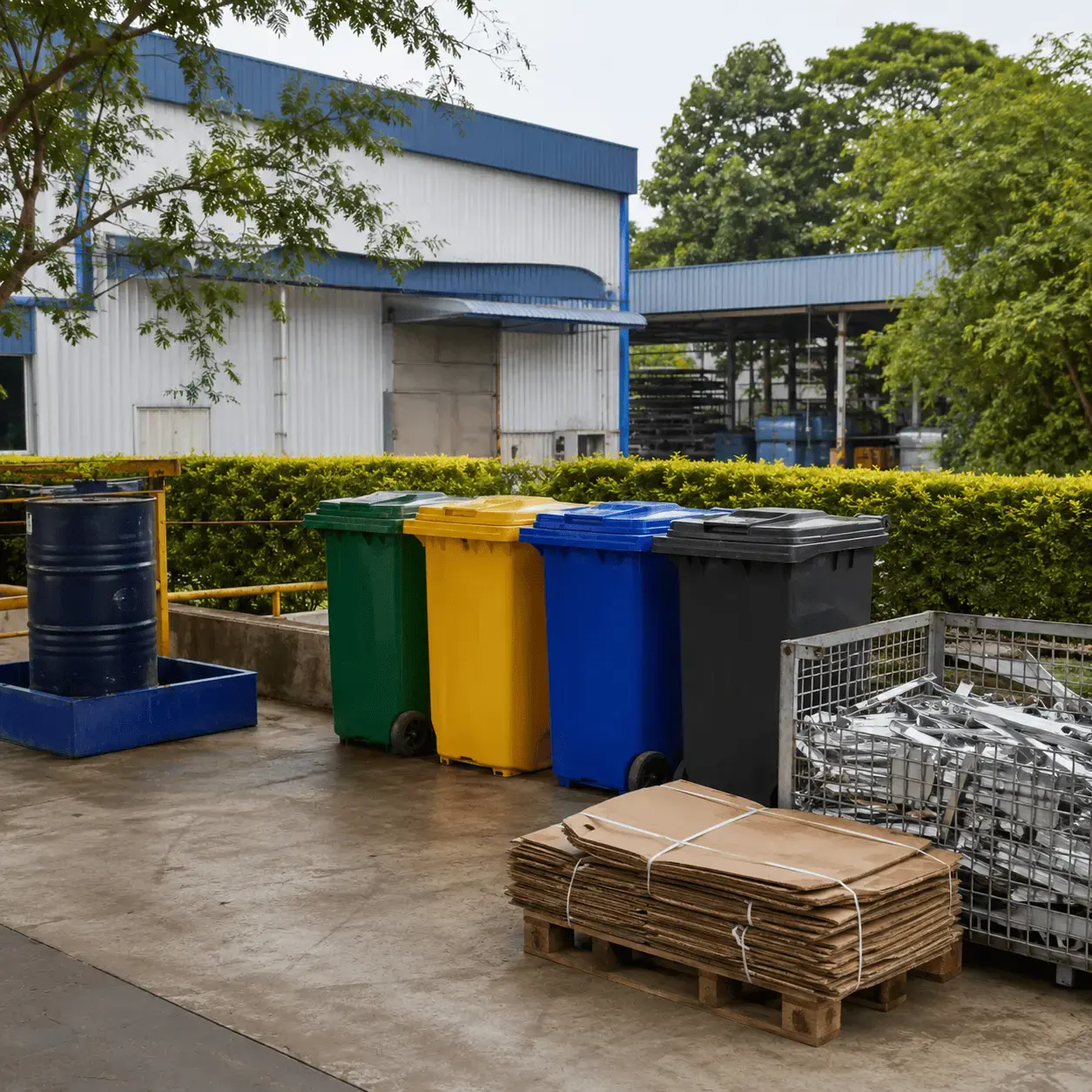
Waste Management in Kenyan Workplaces: Segregation, Storage and Responsible Disposal

WASTE MANAGEMENT · PRACTICAL GUIDE
Waste
Management in Kenyan Workplaces
Segregation, Storage and Responsible
Disposal
A practical
guide to identifying waste streams, preventing unsafe mixing, controlling
temporary storage and maintaining evidence of responsible disposal.
Waste Management in Kenyan Workplaces: Segregation, Storage and Responsible
Disposal
Waste is produced in almost every workplace. Offices discard
paper, packaging and electronic equipment. Construction sites generate rubble,
timber, metal and empty containers. Manufacturing facilities may produce scrap,
used oil, chemical residues and rejected products. Hospitals, laboratories and
food businesses create additional waste streams that require specialised
handling.
The difficulty is not simply removing waste from the
premises. An organisation must understand what it generates, prevent
incompatible materials from being mixed, provide safe temporary storage, use
suitable transporters and retain evidence showing where the waste was taken.
When these controls are weak, ordinary waste can create
fire, health, pollution, injury and reputational risks. Valuable materials may
also be lost because items that could have been reused or recycled become
contaminated.
This guide explains how Kenyan workplaces can build a
practical waste-management process covering prevention, segregation, storage,
collection, disposal and continuous improvement.
What Is Workplace Waste Management?
Workplace waste management is the organised process of
preventing, identifying, separating, handling, storing, transporting,
recovering and disposing of waste produced by an organisation.
It should cover the entire journey of each waste stream.
Moving waste from a work area to a backyard store does not complete the
process. Management should be able to explain what happened from the point of
generation to its final recovery, treatment or disposal.
Kenya’s Sustainable Waste Management Act, 2022 establishes a
framework that supports waste prevention, resource recovery, circular-economy
practices and environmentally sound management. The Environmental Management
and Co-ordination (Waste Management) Regulations, 2024 provide current
requirements and standards governing waste management under EMCA.
Official legal texts: Sustainable Waste Management Act, 2022 and Waste Management Regulations, 2024.
|
KEY PRINCIPLE A workplace remains responsible
for controlling its waste even after the material leaves the department where
it was generated. The organisation should understand who receives it and
whether the next stage is lawful and appropriate. |
Why Proper Waste Management Matters
1. It prevents pollution
Leaks, contaminated runoff, open burning and uncontrolled
dumping can pollute soil, air, drainage systems and water resources. Suitable
containment and disposal arrangements reduce these risks.
2. It protects workers and waste handlers
Broken glass, sharp metal, chemicals, biological material
and heavy containers may cause injuries or harmful exposure when they are mixed
with ordinary waste or handled without adequate information.
3. It supports legal and regulatory compliance
Waste generators must understand the requirements applying
to their waste streams, service providers, records and disposal routes.
Specific activities may require licences, tracking documentation or specialised
controls.
4. It reduces fire and operational risks
Accumulated packaging, oily rags, flammable residues and
obstructed waste stores can increase fire loading, block access routes and
interfere with normal operations.
5. It can reduce costs and recover value
Preventing waste, improving material use and separating
recyclable items can lower purchasing and disposal costs. Clean segregated
material usually has more recovery value than mixed contaminated waste.
6. It strengthens organisational credibility
Customers, employees, regulators and neighbouring
communities expect organisations to manage waste responsibly. Reliable records
and visible controls provide evidence of that responsibility.
Step 1: Identify Every Waste Stream
An effective system begins with a waste inventory. Walk
through each department and record the waste generated during normal work,
maintenance, cleaning, shutdowns, construction activities and emergencies.
Typical workplace waste streams may include:
·
Paper, cartons and packaging materials
·
Food and other biodegradable waste
·
Plastic containers, films and wrapping
·
Scrap metal, timber, glass and rejected products
·
Construction and demolition waste
·
Used oil, oily rags, filters and contaminated
absorbents
·
Chemical residues and empty chemical containers
·
Batteries, lamps, cables and electronic
equipment
·
Healthcare, laboratory or biological waste where
applicable
·
Sludge, dust, ash and treatment residues
For each stream, record its source, estimated quantity,
physical form, hazardous characteristics, current container, storage location,
collection frequency and final destination. Safety data sheets and process
information can help determine whether a material requires specialised
handling.
|
PRACTICAL TEST If employees use the phrase
“general waste” for most discarded materials, the organisation probably does
not yet understand its waste streams well enough. |
Step 2: Prevent and Reduce Waste
The best waste is waste that is never generated. Before
concentrating on bins and collection, examine why materials become waste and
whether the process can be changed.
Waste-prevention measures may include:
·
Purchasing only the quantities that can be used
before expiry
·
Selecting durable, repairable or refillable
products
·
Improving inventory control and material
rotation
·
Reducing process rejects, leaks and unnecessary
offcuts
·
Returning suitable packaging to suppliers
·
Using digital records where printing adds no
operational value
·
Maintaining equipment to prevent product or
material loss
·
Reusing clean materials where this is safe and
technically appropriate
Waste reduction should never compromise product quality,
hygiene or safety. The objective is to eliminate avoidable waste while
preserving required controls.
Step 3: Segregate Waste at the Point of Generation
Segregation means separating waste streams where they arise
rather than attempting to sort them after they have been mixed. This protects
recyclable material, reduces exposure and makes storage and disposal decisions
more reliable.
A practical segregation system should provide:
·
Enough containers for the waste streams
generated in each area
·
Consistent container colours or other
identifiers across the workplace
·
Clear labels using words and simple visual cues
·
Containers suitable for the weight, shape and
properties of the waste
·
Lids where waste may create odour, contamination
or pest problems
·
Rigid puncture-resistant containers for sharps
where applicable
·
Separate arrangements for liquids, hazardous
waste and e-waste
·
Routine checks to identify contamination and
overflowing bins
Colour coding is useful only when it is applied consistently
and employees understand it. The organisation should define its scheme in a
short procedure and display it at waste-generation and storage points.
|
IMPORTANT
Do not rely on colour alone. Lighting, fading, visual
impairment and local variations can cause mistakes. Combine colour with clear
labels and employee instruction. |
Step 4: Handle Hazardous Waste Separately
Hazardous waste may be toxic, corrosive, flammable,
reactive, infectious or otherwise capable of harming people or the environment.
It should not be mixed with general waste, poured into drains or transferred
into unmarked containers.
Controls should reflect the actual material and may include:
·
Compatible, closed and clearly labelled
containers
·
Secondary containment for liquids
·
Separation of incompatible chemicals
·
Restricted access and suitable warning
information
·
Spill kits and emergency instructions
·
Suitable personal protective equipment for
handlers
·
Inspection for leakage, corrosion, damage or
container deterioration
·
Specialised collection and treatment by
appropriately authorised providers
Empty chemical containers should not automatically be
treated as harmless. Residues may remain, and uncontrolled reuse can expose
workers or members of the public. The correct route depends on the original
contents and applicable requirements.
Step 5: Provide a Safe Temporary Waste-Storage Area
The temporary storage area is often where an otherwise good
segregation system fails. Containers may become mixed, labels disappear,
rainwater enters, leaks spread or waste remains for excessive periods.
A well-controlled storage area should be:
·
Clearly designated and protected from
unauthorised access
·
Large enough for the expected waste volumes and
collection intervals
·
Covered or weather-protected where necessary
·
Located away from food areas, ignition sources
and sensitive drainage routes
·
Provided with an impermeable, cleanable floor
where leakage is possible
·
Arranged to keep incompatible materials apart
·
Equipped with spill-control and firefighting
provisions appropriate to the hazards
·
Kept orderly so containers can be inspected and
removed safely
Storage quantities and duration should be monitored. A
collection problem should not be allowed to turn a temporary store into a
permanent uncontrolled dump.
Step 6: Control Collection, Transport and Final Disposal
Waste remains an organisational risk after it passes through
the workplace gate. A low-cost collector who cannot explain the final
destination may expose the organisation to illegal dumping, unsafe recovery or
falsified documentation.
Before engaging a waste service provider, verify:
·
The types of waste the provider is authorised
and equipped to handle
·
The condition and suitability of collection
vehicles and containers
·
Whether waste will be transported directly or
transferred elsewhere
·
The treatment, recovery or disposal facility
that will receive it
·
The documents that will be provided for each
collection
·
The procedure for rejected loads, spills or
transport incidents
·
The validity of relevant licences or approvals
Waste transfer and disposal records should identify the
date, waste type, approximate quantity, transporter and receiving destination.
High-risk streams require stronger traceability than routine office waste.
NEMA publishes waste-management information and regulatory
materials. Review NEMA’s gazetted regulations.
Step 7: Train Employees and Contractors
A waste system cannot work if the people producing and
moving waste do not understand it. Training should be practical, specific to
the workplace and supported by visible instructions.
Employees and contractors should know:
·
Which waste streams are produced in their work
area
·
Which container is used for each stream
·
Which materials must never be mixed
·
How to close, label and move containers safely
·
What to do when a container is full, damaged or
leaking
·
How to report a spill, incorrect disposal or
collection problem
·
Who is responsible for the temporary storage
area and records
Brief refresher instruction should follow changes to
materials, processes, contractors, container systems or legal requirements.
Waste-handling expectations should also form part of contractor induction.
Step 8: Inspect, Measure and Improve
Regular inspection confirms whether the written system is
working in practice. Findings should be recorded, assigned and tracked until
effective correction is verified.
Useful performance indicators may include:
·
Total waste generated by month or production
unit
·
Waste sent for reuse, recycling, treatment and
disposal
·
Contamination rates in segregated containers
·
Number of overflowing, damaged or incorrectly
labelled containers
·
Waste-related spills, complaints and
non-conformities
·
Collection delays and missing documentation
·
Cost of waste handling and value recovered from
recyclable materials
·
Percentage of corrective actions completed on
time
Measurements should support decisions rather than create
paperwork for its own sake. Begin with a small set of indicators the
organisation can collect consistently, then improve the system as the data
becomes more reliable.
Common Waste-Management Mistakes
·
Providing coloured bins without labels or
employee training
·
Mixing hazardous waste with general waste
·
Allowing waste containers to overflow
·
Keeping unidentified drums and containers in
storage
·
Storing liquids without secondary containment
·
Placing waste near drains, ignition sources or
emergency routes
·
Burning waste in the open
·
Using a collector without verifying the final
destination
·
Failing to retain transfer and disposal records
·
Treating an annual audit as a substitute for
routine inspections
·
Leaving corrective actions open without
responsibility or deadlines
Practical Workplace Waste-Management Checklist
·
☐ Have all routine and non-routine waste streams
been identified?
·
☐ Do we know which waste streams are hazardous
or require specialised handling?
·
☐ Is waste prevented or reduced where reasonably
practicable?
·
☐ Are suitable containers available at the point
of generation?
·
☐ Are containers consistently labelled and
correctly used?
·
☐ Are incompatible materials kept separate?
·
☐ Is the temporary storage area secure, covered
and orderly?
·
☐ Are liquid wastes protected by suitable
secondary containment?
·
☐ Are collection frequencies adequate for the
quantities generated?
·
☐ Have service providers and receiving
facilities been verified?
·
☐ Can every significant waste collection be
traced to its destination?
·
☐ Are employees and contractors trained on the
workplace system?
·
☐ Are inspections documented and corrective
actions completed?
·
☐ Are waste quantities, costs and recovery
opportunities reviewed?
|
ACTION
Any “no” or “not sure” answer should become a defined
follow-up action with an owner and completion date. |
How Safetec Solutions Limited Can Help
Safetec Solutions Limited supports organisations in
assessing and improving workplace waste-management arrangements.
Professional support can assist with:
·
Waste-management audits and workplace
inspections
·
Waste-stream identification and classification
support
·
Development or review of waste-management plans
·
Segregation, labelling and temporary-storage
arrangements
·
Environmental legal and compliance reviews
·
Contractor and disposal-route evaluation
·
Employee awareness and practical training
·
Corrective-action planning and follow-up
The appropriate controls depend on the organisation’s
activities, the properties of its waste and the applicable national and county
requirements.
|
CONSIDER THIS Can your organisation account
for its waste from the point where it is generated to the place where it is
finally recovered, treated or disposed of? |
Visit www.safetec.co.ke to learn more or request
professional environmental support.
Frequently Asked Questions
What is waste segregation?
Waste segregation is the separation of different waste
streams at the point where they are generated. It prevents contamination and
supports safer handling, recycling, treatment and disposal.
Does every workplace need several coloured bins?
The number and type of containers should reflect the waste
streams actually produced. Colour coding can support recognition, but
containers should also be clearly labelled and employees trained on the system.
Can empty chemical containers be placed in general waste?
Not automatically. Residues may remain and the container may
require controlled handling. The correct decision depends on the original
substance, container condition and applicable requirements.
What records should a workplace keep?
Relevant records may include waste inventories, inspection
forms, collection records, transfer or tracking documents, service-provider
approvals, incident reports, training records and evidence of final treatment
or disposal.
Who is responsible after waste leaves the workplace?
Different parties have specific duties, but the waste
generator should exercise due diligence. The organisation should verify the
transporter and receiving destination rather than assuming responsibility ends
at collection.
How often should a waste-management system be reviewed?
Review it periodically and whenever materials, processes, waste quantities, storage arrangements, contractors or legal requirements change. Incidents, complaints and audit findings should also trigger review.
External Links and Authoritative References
Kenya Law – Sustainable Waste Management Act, 2022
National framework for sustainable waste
management, resource recovery and circularity.
Kenya Law – Waste Management Regulations, 2024
Current subsidiary legislation governing waste
management under EMCA.
Kenya Law – Environmental Management and Co-ordination
Act
The principal environmental-management statute
under which NEMA operates.
NEMA
– Gazetted Regulations 2024
Official summary of the 2024 environmental
regulations, including waste management and EPR.
NEMA – National Solid Waste Management Strategy
National strategic guidance for systematic
improvement of solid-waste management.
NEMA
– Waste-Management Awareness Materials
Official public resources on sustainable waste
management and circular economy.
NEMA – Extended Producer Responsibility
Information and downloads relating to Kenya’s
EPR requirements.
Environmental, occupational safety and
compliance support for organisations.