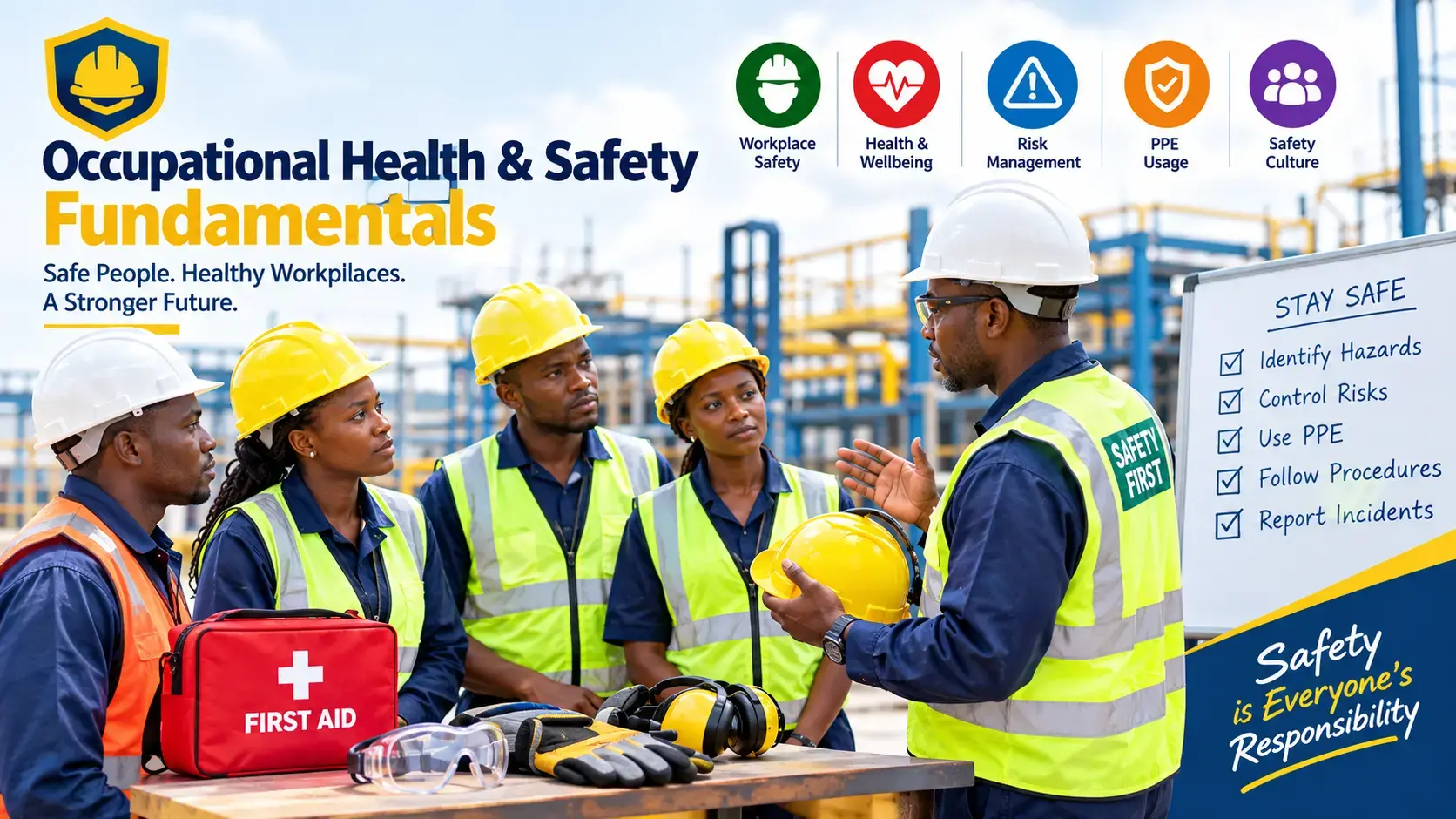
Course Overview
Occupational Health & Safety (OHS) Fundamentals
is a comprehensive introduction to the principles, practices, and
responsibilities required to create and maintain a safe and healthy workplace.
The training helps employees, supervisors, managers, and safety representatives
understand workplace hazards, assess risks, implement appropriate controls,
respond to incidents, and promote a strong safety culture.
The course focuses on preventing workplace injuries,
illnesses, property damage, and unsafe conditions through practical hazard
identification, risk management, safe work practices, emergency preparedness,
and continuous improvement.
1. Introduction to Occupational Health & Safety
Participants are introduced to the fundamental concepts of
workplace health and safety, including:
- The
purpose and importance of occupational health and safety.
- Common
causes of workplace injuries and occupational illnesses.
- Employer,
supervisor, and employee safety responsibilities.
- The
importance of proactive hazard prevention.
- Workplace
safety culture and employee participation.
- The
relationship between safety, productivity, and business continuity.
2. Workplace Hazard Identification
Participants learn how to identify hazards that may affect
employees, visitors, contractors, equipment, and the surrounding environment.
Common workplace hazards include:
- Physical
hazards.
- Chemical
hazards.
- Biological
hazards.
- Ergonomic
hazards.
- Electrical
hazards.
- Fire
and explosion hazards.
- Mechanical
and equipment hazards.
- Environmental
hazards.
- Psychosocial
and work-related stressors.
- Slips,
trips, and falls.
- Workplace
violence and other security-related hazards where applicable.
3. Risk Assessment and Risk Management
The course introduces systematic methods for assessing
workplace risks. Participants learn how to:
- Identify
hazards.
- Determine
who may be exposed.
- Assess
the likelihood and potential severity of harm.
- Prioritize
risks.
- Select
appropriate control measures.
- Implement
controls.
- Monitor
their effectiveness.
- Review
assessments when workplace conditions change.
4. Hierarchy of Controls
Participants learn how to select controls based on their
effectiveness, including:
- Elimination
— removing the hazard entirely.
- Substitution
— replacing a hazardous process, substance, or equipment with a safer
alternative.
- Engineering
controls — physically separating people from hazards.
- Administrative
controls — using procedures, training, scheduling, signage, and other
management measures.
- Personal
Protective Equipment (PPE) — providing appropriate protective
equipment where hazards cannot otherwise be adequately controlled.
5. Personal Protective Equipment
The training covers the appropriate selection, use,
inspection, storage, and maintenance of PPE, which may include:
- Safety
helmets.
- Safety
footwear.
- Protective
gloves.
- Eye
and face protection.
- Hearing
protection.
- Respiratory
protection.
- Protective
clothing.
- Fall-protection
equipment.
- High-visibility
clothing.
Participants learn that PPE should complement, rather than
replace, higher-level hazard controls where those controls are reasonably
practicable.
6. Safe Work Practices
Participants are introduced to practical measures for
reducing workplace risks, including:
- Following
established safe-work procedures.
- Maintaining
good housekeeping.
- Using
tools and equipment correctly.
- Reporting
unsafe conditions.
- Following
warning signs and safety instructions.
- Maintaining
clear access and emergency routes.
- Avoiding
unauthorized work or unsafe shortcuts.
- Performing
pre-use checks where required.
7. Manual Handling and Ergonomics
The course addresses common risks associated with lifting,
carrying, pushing, pulling, repetitive tasks, and workstation design.
Topics may include:
- Identifying
manual-handling hazards.
- Safe
lifting principles.
- Appropriate
use of mechanical aids.
- Reducing
unnecessary manual handling.
- Ergonomic
workstation setup.
- Proper
positioning and posture.
- Managing
repetitive or prolonged tasks.
- Early
reporting of work-related discomfort or injuries.
8. Electrical Safety
Participants learn basic electrical-safety principles,
including:
- Recognizing
electrical hazards.
- Identifying
damaged cords, plugs, and equipment.
- Avoiding
contact with exposed electrical components.
- Using
electrical equipment appropriately.
- Keeping
electrical systems away from unsuitable environments.
- Understanding
the importance of isolation and authorized maintenance.
- Reporting
electrical defects promptly.
Only appropriately qualified and authorized personnel should
undertake electrical work requiring specialist competence.
9. Fire Safety and Emergency Preparedness
OHS fundamentals also introduce emergency preparedness,
including:
- Fire
prevention.
- Fire
alarms and emergency notification.
- Emergency
evacuation.
- Emergency
exits and assembly points.
- Basic
awareness of fire-fighting equipment.
- Emergency
communication.
- Incident
reporting.
- Emergency
response responsibilities.
10. Chemical and Hazardous Substance Safety
Participants learn the basic principles of safely managing
hazardous substances, including:
- Identifying
hazardous chemicals.
- Understanding
labels and safety information.
- Safe
storage and handling.
- Preventing
exposure.
- Using
appropriate PPE and controls.
- Responding
to spills and accidental exposure.
- Maintaining
appropriate documentation and procedures.
11. Machinery and Equipment Safety
The course introduces fundamental principles for working
safely around machinery and equipment, including:
- Using
equipment only as intended.
- Recognizing
moving-part hazards.
- Guards
and protective devices.
- Pre-use
inspections.
- Safe
operating procedures.
- Isolation
and lockout procedures where applicable.
- Reporting
defects.
- Preventing
unauthorized operation.
12. Slips, Trips, Falls, and Work at Height
Participants learn how to prevent common fall-related
incidents through:
- Good
housekeeping.
- Clear
walkways.
- Appropriate
signage.
- Proper
storage of materials.
- Safe
use of ladders and access equipment.
- Appropriate
fall-protection measures where required.
- Recognizing
unsafe work-at-height conditions.
13. Occupational Health and Workplace Hygiene
The course addresses workplace conditions that can affect
employee health, including:
- Workplace
cleanliness.
- Hygiene
practices.
- Exposure
to hazardous substances.
- Noise.
- Dust
and airborne contaminants.
- Ventilation.
- Temperature
and environmental conditions.
- Biological
hazards.
- Occupational
exposure prevention.
- Health
surveillance where required.
14. Incident, Accident, and Near-Miss Reporting
Effective reporting helps organizations identify hazards
before they cause further harm. Participants learn how to:
- Report
accidents and injuries promptly.
- Report
near misses.
- Report
unsafe conditions.
- Preserve
relevant information after an incident.
- Participate
appropriately in investigations.
- Understand
corrective and preventive actions.
- Avoid
concealing incidents or hazards.
15. Emergency Response
Participants are introduced to appropriate responses to
workplace emergencies, including:
- Raising
the alarm.
- Contacting
emergency services.
- Evacuating
safely.
- Providing
assistance within their level of training.
- Following
emergency procedures.
- Reporting
hazards to responsible personnel.
- Supporting
emergency response teams.
16. Safety Signs, Symbols, and Communication
Participants learn to recognize common safety communication
methods, including:
- Warning
signs.
- Prohibition
signs.
- Mandatory-action
signs.
- Emergency
information signs.
- Fire-safety
signs.
- Hazard
labels.
- Workplace
safety notices.
- Safety
instructions and procedures.
17. Safety Responsibilities and Employee Participation
A successful OHS program requires participation throughout
the organization. The course emphasizes:
- Individual
responsibility for safe work.
- Supervisor
responsibilities.
- Management
commitment.
- Reporting
and consultation.
- Safety
meetings and toolbox talks.
- Following
established procedures.
- Participating
in training and drills.
- Supporting
continuous safety improvement.
18. Safety Culture and Continuous Improvement
Participants learn how organizations can develop a positive
safety culture by:
- Demonstrating
management commitment.
- Encouraging
hazard reporting.
- Learning
from incidents and near misses.
- Communicating
safety expectations.
- Providing
appropriate resources and training.
- Monitoring
safety performance.
- Reviewing
and improving workplace controls.
Learning Outcomes
After completing Occupational Health & Safety
Fundamentals training, participants should be able to:
- Explain
fundamental occupational health and safety principles.
- Recognize
common workplace hazards.
- Conduct
or contribute to basic workplace risk assessments.
- Apply
the hierarchy of controls.
- Select
and use appropriate PPE.
- Follow
safe work practices.
- Recognize
common fire, electrical, chemical, ergonomic, and machinery hazards.
- Respond
appropriately to workplace emergencies.
- Report
accidents, near misses, and unsafe conditions.
- Understand
basic workplace health and hygiene requirements.
- Contribute
positively to the organization's safety culture.
Target Audience
This training is suitable for:
- Employees
and new staff.
- Supervisors
and team leaders.
- Managers.
- Health
and safety representatives.
- Contractors
and temporary workers.
- Workplace
emergency-response personnel.
- Organizations
introducing employees to OHS requirements.
- Anyone
seeking foundational workplace health and safety knowledge.
Overall Objective
The overall objective of Occupational Health & Safety
Fundamentals is to provide participants with a practical understanding of
workplace hazards, risk assessment, hazard controls, emergency preparedness,
safe work practices, and individual safety responsibilities, enabling them to
contribute to a safer, healthier, and more responsible working environment.
Training content should be adapted to the organization's
activities, workplace hazards, applicable legislation, and relevant
occupational health and safety standards.
Learning Objectives
Course Requirements
• Be able to understand and follow basic workplace safety instructions.
• Have a basic ability to communicate and participate in classroom discussions and activities.
• Be willing to participate in practical exercises, discussions, hazard-identification activities, and assessments.
• Bring or use appropriate workplace PPE where practical activities require it.
• Participants attending workplace-specific training should be familiar with their organization's basic safety policies and procedures, where available.
• Be prepared to participate in safety exercises such as hazard identification, risk assessment, workplace inspections, and emergency response activities.
• Any relevant accessibility, medical, or participation requirements should be communicated to the training provider in advance so appropriate arrangements can be considered.
Recommended Prerequisite
No formal prerequisite is generally required for Occupational Health & Safety Fundamentals training. The course is suitable for employees, supervisors, managers, contractors, safety representatives, and individuals who are new to occupational health and safety.
Important Note
Training content should be adapted to the participant's industry, workplace hazards, job responsibilities, and applicable occupational health and safety legislation or standards. Where participants have specific safety responsibilities, additional role-specific training may be appropriate.